
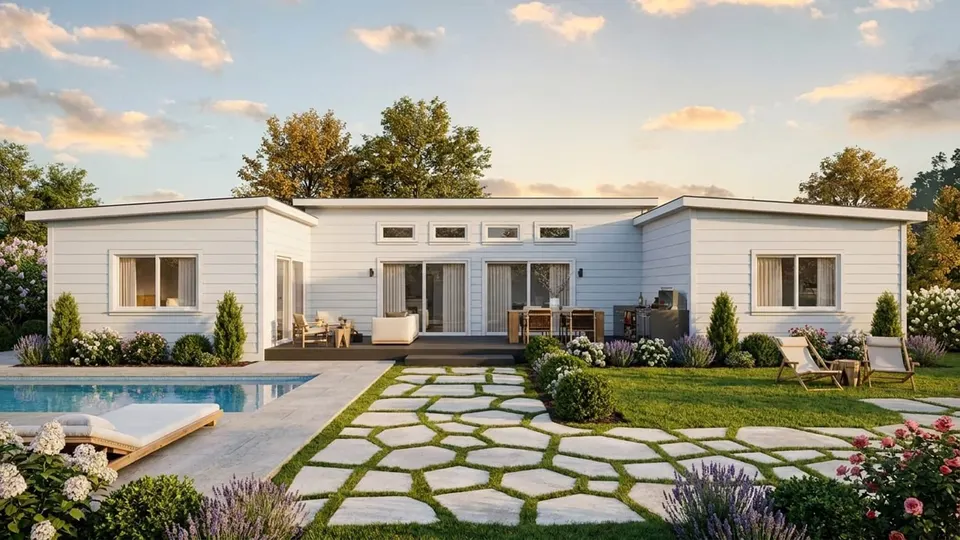
The Homes · Multiple Units Per Lot
More than one unit. Same factory.
California's 2020s housing reforms unlocked a new playbook: build multiple housing units on lots that used to fit one house. For homeowners, that means an ADU + JADU on the same lot. For developers, it can mean 4–8 doors per parcel. We build both.
Four Real Scenarios
How multi-family builds actually work in California today.
-
Up to 1 detached ADU + 1 JADU on most single-family R1 lots
Two detached ADUs on one single-family lot
California law (SB 9 and ADU statute) allows a primary residence + one detached ADU + one JADU on most single-family lots. We build the detached ADU half of that equation. Some lots qualify for two detached ADUs depending on city.
-
3 units total: main house + JADU + detached ADU
ADU + JADU combination
JADU = Junior ADU, a smaller unit converted from existing space within the main house (up to 500 ft²). Pair a JADU inside the existing home with a detached Framework First ADU in the backyard to create a 3-unit property from a single-family lot.
-
Up to 4 units on what was 1 lot, varies by city
SB 9 lot split + two homes
California Senate Bill 9 (2022) lets owners of single-family lots split the lot into two parcels (subject to local rules) and build up to two units on each new parcel. The math gets complex, but for the right lot it can mean 4 doors on what was previously a single-family parcel.
-
4–8 units typical, contact us for larger scope
Small-scale multi-unit residential development
For developers and investors building 4–8 unit projects on properly zoned multi-family lots (R2, R3), we provide factory-built units that can be combined and delivered as a coordinated project. This is closest to our "Home Development" service line.
Multi-Unit Economics
The income math is genuinely different.
A single 660 ft² 2BR ADU rents for $2,400–$2,800/mo in our service area. Add a second unit (a JADU at $1,200–$1,800/mo) and the property's gross rental potential jumps to roughly $3,600–$4,600/mo from what was originally a single-family home. Property value generally tracks income, so multi-unit properties typically appraise meaningfully higher than the cost-to-build.
- A permitting budget per unit
- Single coordinated application across the units on your lot, no separate permit-broker engagements. Actual permit costs are set by your city and confirmed in your feasibility study.
- Foundation per unit
- Each unit gets its own foundation, poured in parallel with factory builds.
- Utility splits
- Separate water/electrical/gas meters per unit (where required for rental separability).
- Privacy planning
- Window placement, fencing, and entrance orientation designed so units feel like real separate homes, not duplexes.
- Deliveries coordinated
- Each unit crane-delivered on its scheduled day. We schedule units sequentially so site access stays manageable.
- All-inclusive per unit
- Each unit's price is locked at contract, with a permitting budget built in. Permit costs and any property-specific site work are confirmed in your feasibility study.
$3,600–4,600
monthly rent · 2-unit property
~115%
of cost added to home value
5–9
months factory build per unit
Value-add assumption: California average for a permitted, site-delivered ADU
Honest Caveats
What's hard about multi-unit (so you can plan around it).
Permitting is more complex. Two units on a single lot doesn't double the permitting work; it is more like 1.5x's it. Cities want to see how units relate, parking, drainage, sometimes additional fire-access requirements. Plan for a 3 to 6 month permitting window vs roughly 60 days for a single ADU. See our permit timeline guide.
Utility costs scale non-linearly. One ADU usually attaches to the existing sewer and electrical. Two ADUs may exceed the existing service capacity and trigger upgrades at the street. Budget $10K–$40K for utility upgrades when going from 1 to 2 units. Our feasibility study identifies this for your specific lot.
Financing is different. Multi-unit construction loans look more like commercial-real-estate underwriting than residential. Our partners (Mason Mac and SearchLight Lending) handle this, but the qualification math weighs projected rental income heavily.
SB 9 lot splits aren't universal. SB 9 allows lot splits in single-family zones statewide, but cities have implementation details: minimum lot sizes for the resulting parcels, dimensional standards, etc. Some lots qualify; many don't. We confirm during the feasibility study.
Multi-Unit Feasibility
Let's see what your lot can support.
Multi-unit lot analysis is included in our standard feasibility study. Tell us about your property below and mention how many units you're considering; we'll follow up with what your lot can host.
- A shortlist of which models actually fit your lot
- Honest flags on anything property-specific, like slope or septic
- A clear next step, whether that is a factory tour or a feasibility study
- No pressure, and no obligation
Building more than one? If you're a real estate developer or investor planning multiple units, let us know in the form. We offer better pricing at volume.
“My first telephone conversation with Cathy (Owner) was one of the best, positive and kind discussions. She was thinking outside of the box and provided a possible solution like a family member. Thank you.”
Vijay Kumar
on Google
We respect your inbox and your phone. Message and data rates may apply, message frequency varies, reply STOP to opt out or HELP for help. See our Privacy Policy and Terms & Conditions.