Local Guides - Santa Cruz
ADU Setback Requirements in Santa Cruz, California

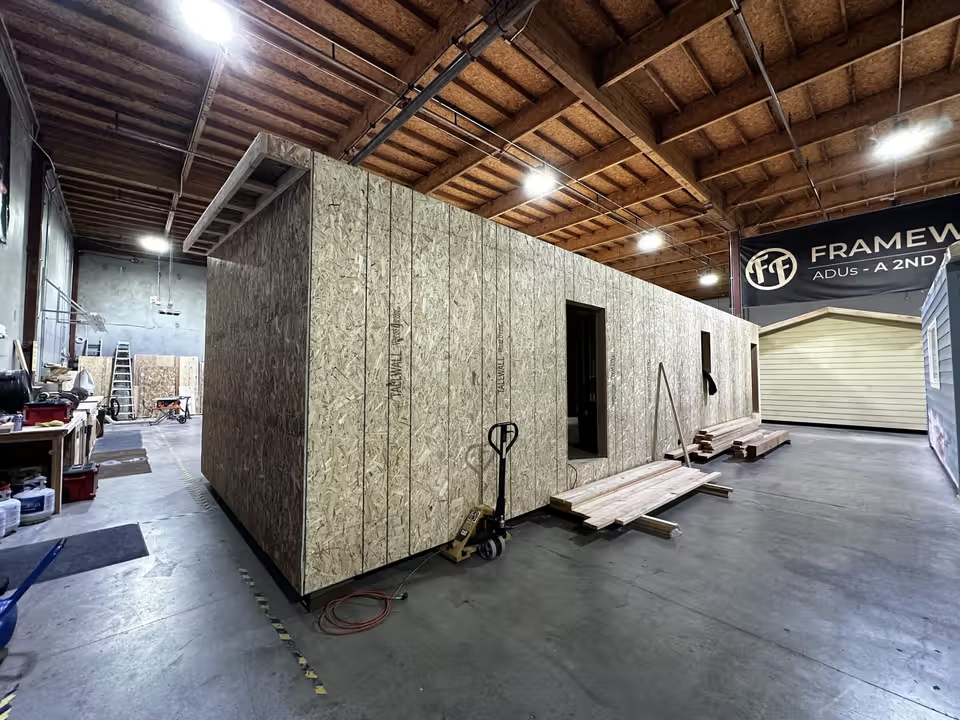
If you have walked a lot in Santa Cruz, you already know the challenge: narrow parcels, mature trees, retaining walls, and slopes that do not leave much flat, buildable ground. Before you can sketch anything on that lot, you need to know your setbacks, the required gap between a structure and your property lines. Get the setback wrong and a design that looked great on paper will not fit once a surveyor stakes the actual lines. This is exactly where factory built precision earns its keep. We build to the same tight tolerances in our Salinas factory every time, then crane the finished home onto your lot, about 40 minutes away, so what we planned for your setbacks is what actually shows up.
On this page
What a setback actually controls
A setback is simply the minimum distance a building has to keep from a property line. Interior side setbacks apply to the shared lines with your neighbors, rear setbacks apply to the back line, and front setbacks apply to the line facing the street. Setbacks exist to keep light, air, and a bit of breathing room between structures, and they are one of the first things that determines whether a given ADU size and shape will actually sit on your particular lot.
The numbers for a detached ADU in Santa Cruz
Santa Cruz has its own published standard for detached, newly constructed ADUs, and it is more generous than a lot of cities default to. A new detached ADU only needs 3 feet of interior side and rear setback. That is a local rule, not a statewide minimum, and it is a meaningful advantage on the narrow lots this city is known for. There is a height related wrinkle worth knowing: any part of the structure that rises above 16 feet has to sit back at least 4 feet instead of 3. As for how tall you can build, a non-exempt detached ADU in Santa Cruz can reach 22 feet to the roof peak, also a local standard. If your unit qualifies under one of the state’s exemption categories instead, it follows California’s own 16 to 20 foot height ladder.
Size is capped separately from setback and height. Santa Cruz allows a new detached ADU to be the larger of 10 percent of your net lot area, up to a maximum of 1,200 square feet, or a flat minimum of 850 square feet for a studio or one bedroom unit and 1,000 square feet for a two bedroom or larger unit. Whichever of those numbers is bigger on your lot is what you get to build toward, setbacks and height limits permitting.
The state’s safety net for tight lots
Even on a genuinely small or oddly shaped Santa Cruz parcel, California law puts a floor under all of this. Every city and county in the state, Santa Cruz included, has to allow at least an 800 square foot, 16 foot tall ADU with only 4 foot side and rear setbacks, regardless of what the local formula would otherwise produce. In practice this means there is almost always a legally guaranteed path to a real, livable ADU, even on the tightest lot in town.
How setbacks and height add up to your buildable envelope
Setbacks and height limits are not separate questions, they work together to define what we call the buildable envelope, the actual three dimensional space on your lot where a structure is allowed to exist. Draw your setback lines in from each property boundary, then think about how the 16 foot height threshold pulls the envelope in further as the walls climb toward that 22 foot peak. On a flat, generous lot that envelope is simple. On a sloped, narrow Santa Cruz lot, it gets complicated fast, which is exactly why we built free tools instead of asking you to picture it in your head. Our Yard-Fit Visualizer lets you see your setback lines and buildable area laid over your actual lot shape, and our Property Report pulls your specific parcel data so the numbers are not generic.
Your front setback is a different question
Everything above covers interior side and rear setbacks for a new detached ADU. Front setback works differently: it follows the zoning that already applies to your main home, not a separate ADU specific standard. That number depends on your zoning district and your existing house’s placement on the lot, so we confirm it as part of your free property analysis rather than quoting a single citywide figure here.
For the full picture, including citations back to the specific municipal code sections and state statutes behind every number above, our ADU Rules Lookup has a dedicated Santa Cruz entry you can check anytime.
Frequently asked questions
Can setbacks be reduced if I convert an existing structure instead of building new?
The 3 foot interior side and rear standard above is written specifically for new construction. If you are converting an existing detached structure, like a garage, into an ADU, you are generally not required to move the existing exterior walls to meet a new setback distance, since those walls already stand where they stand. We will confirm exactly how this applies during your property analysis, since it depends on the specific structure and its condition.
What happens if my lot is too small for the standard size formula?
This is exactly what the state’s guaranteed minimum is for. Even where Santa Cruz’s 10 percent of net lot area formula would produce a small number, California law requires the city to allow at least an 800 square foot, 16 foot tall ADU with 4 foot side and rear setbacks no matter what. Small and tight lots are common in Santa Cruz, and this floor is what makes an ADU realistic on most of them.
Do setbacks change if I build taller than 16 feet?
Yes. Up to 16 feet, Santa Cruz’s detached ADU setback is 3 feet on the interior sides and rear. Any portion of the structure above 16 feet needs at least 4 feet of setback instead. Since a non-exempt detached ADU here can reach 22 feet to the roof peak, this matters for anything with a full second story or a taller roofline.
Is the front setback the same 3 foot number as the sides and rear?
No. Front setback is tied to your main home’s existing residential zoning, not to the ADU specific standard that governs interior side and rear setbacks. It varies by property, which is why we pull your actual zoning and confirm your front setback as part of the free property analysis rather than publishing one number for the whole city.
Ready to see your own numbers
Setback math on a real, sloped Santa Cruz lot is not something you want to eyeball. Start with a free property analysis and we will pull your actual zoning, run your lot through the Yard-Fit Visualizer, and tell you plainly what will and will not fit. If you want to go a step further, a feasibility study is $497 for a standard lot or $997 for a vacant lot, and it credits toward your build; it is only refundable if your property genuinely cannot host an ADU. The separate $1,000 signup deposit is refundable if your financing falls through. If you are still working out how to pay for the project, our guides on financing an ADU in California, HELOC versus a construction loan, and ADU loans in California walk through the common paths, including HELOCs, cash out refinances, and construction loans against home equity.
For the rest of the Santa Cruz picture, see how the permit process works, what a realistic project timeline looks like, and what an ADU costs in Santa Cruz.
Free Tool
Santa Cruz ADU rules lookup →
Answer a few questions and get the ADU rules for your Santa Cruz property, cited to official sources.
Free Tool
Free Santa Cruz property report →
Type your address and see your lot, what fits on it, and the local rules in one report.
More on building here: ADUs in Santa Cruz · Santa Cruz County ADU regulations