
ADU Questions · 2026
Building a Home on a Vacant Lot in California: What Changes
Building on a truly vacant lot, one with no existing structure, no water or sewer line already run to it, and no electrical panel to tie into, is a meaningfully different project than the ADU scenario most homeowners picture: a unit going up in a backyard behind a house that already has all of that infrastructure in place. On an empty lot, some of what a homeowner with an existing house takes for granted, a water meter at the curb, a sewer lateral already stubbed in, a panel with spare capacity, has to be planned and built from the ground up. None of that makes a vacant lot unbuildable, it just changes what the feasibility study looks at, what site prep involves, and what has to happen before a crane can set a home on its foundation.
The short version: A vacant lot needs water, sewer or septic, and electrical service run to the property instead of tapped off an existing house, which is why Framework First’s empty-lot feasibility study is a separate, more thorough tier than the standard one, $997 and 14 business days instead of $497 and 7. Septic and soil testing, grading, and crane access all get evaluated as part of that process, before you commit to a model.
Why a vacant lot is a different starting point
Most ADU projects start from a property that already has a house on it. That existing house comes with a water meter, a sewer lateral or septic system already sized for a household, and an electrical panel with a known amount of spare capacity. On a lot like that, the feasibility question is mostly about capacity: can the existing service handle a second dwelling, or does it need a dedicated connection of its own. Our companion post on how ADU utility hookups work walks through exactly how that gets decided.
A vacant lot doesn’t have any of that to check against. There’s no water meter to evaluate, no sewer lateral to measure, no panel to inspect. The feasibility study has to establish, from nothing, what it will take to bring water, sewer or septic, and electrical service to a specific point on a specific piece of land. That’s a genuinely different kind of evaluation, and it’s why it’s priced and scheduled as its own tier rather than folded into the standard study.
This applies to two situations that look different on paper but create the same planning problem. One is building a primary home on a vacant lot with nothing on it at all, which we cover in more detail in can a prefab ADU be a primary home. The other is a large property that already has a house, but where the buildable area for a new ADU sits in a detached corner of the lot, far from the existing utility lines. In both cases, the home is effectively starting from a blank slate for infrastructure, even though only one of them is technically an “empty lot.”
Utility hookups have to be run from scratch
On a property with an existing house, utility hookups are mostly a question of shared versus dedicated service. On a vacant lot, there’s no shared option, everything has to be run new.
- Water. A new service line has to connect the property to the utility main, typically from the street, along with a new meter. Distance from the main, and whether the street already has a stub for the parcel, both affect scope and cost.
- Sewer or septic. If public sewer is available nearby, a new lateral has to be trenched from the property to the main. If it isn’t, or if the lot is in an area that relies on individual systems, a septic system has to be designed and installed, which is its own process covered in ADU septic system requirements.
- Electrical. A new service drop and panel have to be installed, sometimes with a longer run from the transformer or pole than a backyard ADU would ever need. Does an ADU need a separate utility meter covers how that decision typically gets made, though on a vacant lot a dedicated meter is closer to the default than the exception.
- Gas. Many vacant-lot builds skip a new gas connection entirely and go all-electric instead, since running a new gas line from the street adds its own cost and timeline.
None of this means a vacant lot is a bad project. It means the utility scope is a real line item that has to be sized for your specific parcel, which is exactly what the feasibility study exists to do before you’re locked into a model or a budget.
The feasibility study is the empty-lot tier
Framework First runs two tiers of feasibility study, and which one applies depends entirely on whether your property already has a house on it. The standard study is $497 and takes 14 business days. The empty-lot study is $997 and takes 21 business days, because there’s more original ground to cover: no existing utility connections to reference, no existing structure to work around, and often a soils and access evaluation a backyard ADU project doesn’t need at all. Both tiers are refundable if the study finds your lot can’t actually host what you’re planning.
That extra time and cost buys a real answer instead of a guess. Where a backyard study is mostly confirming capacity on infrastructure that already exists, an empty-lot study has to establish where water, sewer or septic, and electrical service can realistically connect, and what the true all-in picture looks like once that groundwork is priced. More on the process itself on the feasibility study page.
Septic and soil testing
If your vacant lot isn’t near an existing public sewer connection, a septic system is likely part of the plan, and that means soil percolation testing has to happen before the design can be finalized. A percolation test measures how quickly water moves through the soil, which determines how large a leach field the property needs and, in some cases, where on the lot it can actually go.
This matters more on a vacant lot than it does on a backyard ADU project, because on an empty parcel the septic system and the buildable footprint are being planned together for the first time. The results of that soil testing can genuinely shape where the home ends up sitting on the property, which is one more reason this gets evaluated before you fall in love with a specific floor plan. Our post on ADU septic system requirements goes into more depth on how that evaluation works and what an upgrade or new system can involve.
Access and grading
An existing property usually already has a driveway and a reasonably clear path from the street to wherever the ADU is going. A vacant lot often doesn’t, and that changes what has to happen before delivery day. Grading may be needed to create a stable, level path for a delivery trailer and enough open, solid ground for a crane to safely position itself and lift the home onto its foundation. Brush, uneven terrain, or a lack of any existing access point are all things the feasibility study and a follow-up site visit are built to catch early, rather than discovered the week a crew shows up.
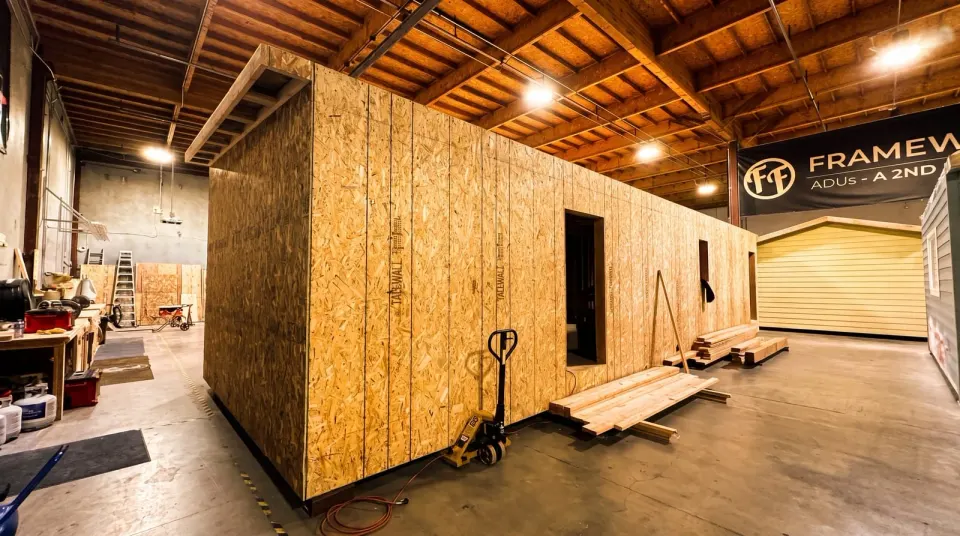
Once grading and access are confirmed, the rest of the build follows the same sequence as any Framework First project: a foundation crew works the site while your home is built in parallel inside the Salinas factory, and the finished unit is crane-delivered once both tracks are ready.
Two versions of the same scenario
Worth being explicit that “vacant lot” covers two situations that come up with real homeowners. The first is a genuinely empty parcel where you’re building a primary residence with nothing else on the property, covered separately in can a prefab ADU be a primary home. The second is a larger property that already has a main house, but where the spot you want an ADU is detached and some distance from the existing home’s utility lines. Both solve the same underlying problem, getting service to a location that doesn’t currently have any, and both get evaluated the same way, through the empty-lot feasibility tier.
Frequently asked questions
Does building on a vacant lot cost more than building on a lot with an existing house?
It can, because utility connections, and sometimes site grading, have to be built from scratch rather than tapped off existing service. How much more depends entirely on your specific lot, how far it sits from water, sewer, and electrical mains, and what the soil and access conditions look like. That’s exactly what the empty-lot feasibility study is designed to price out before you commit to a model.
How long does it take to run water, sewer, and electrical service to a vacant lot?
It varies by utility provider and by how far the property sits from existing mains, so there’s no single answer that applies everywhere. Your feasibility study identifies what each connection realistically requires for your specific parcel, and that scope gets built into your project timeline from the start rather than discovered partway through.
Do I need a septic system if I build on a vacant lot?
Only if the lot isn’t near an available public sewer connection. Where public sewer is accessible, a new lateral can usually be trenched to the main instead. Where it isn’t, a septic system has to be designed and sized based on soil percolation testing, which is confirmed during the feasibility process before your design is finalized.
What if the buildable part of my property is far from the street or the existing house?
That’s treated the same way as a fully vacant lot, because the underlying problem, utilities that aren’t already present at the build site, is the same. This is common on larger properties where the most sensible ADU location sits away from the main home’s existing lines. The empty-lot feasibility study evaluates that distance and what it takes to bridge it.
Can Framework First build a primary home on a vacant lot, not just an ADU?
Yes. The utility, septic, and access considerations covered here apply to both a standalone primary home and an ADU on an undeveloped parcel. Can a prefab ADU be a primary home covers the design and structural side of that question in more detail.
Curious what your specific vacant lot would need? Start an empty-lot feasibility study to get real answers on utilities, septic, and access, or browse our models to see what could fit once the groundwork is scoped.