ADU Laws · 2026
Santa Clara County ADU Requirements (2026)

Santa Clara County ADU rules start with California state law, which every city in the county must follow: cities must allow an ADU of at least 850 sq ft (1,000 sq ft with two or more bedrooms), side and rear setbacks can be no more than 4 feet, and a complete application on a lot with an existing home must be approved or denied within 60 days.
Most homes sit inside a city, such as San Jose, Sunnyvale, Gilroy, Morgan Hill or Los Gatos, so your city’s ADU ordinance sets the details on top of that baseline. Unincorporated parcels follow the County of Santa Clara. Below we walk through the state floor first, then how the cities we build in most actually differ, then the County itself.
The short version: State law is the floor in all 16 permitting jurisdictions here (15 cities plus the County): ministerial approval with no public hearing, a 60-day decision on a complete application when there is an existing home on the lot, side and rear setbacks of no more than 4 feet, no owner-occupancy requirement for a standard ADU, and no impact fees at 750 sq ft or less. Cities set the rest, and they really do differ. San Jose applies state law directly, Gilroy caps detached ADUs at 1,000 sq ft, and Morgan Hill and Los Gatos write their standards into their own codes. We confirm which rules govern your parcel before you commit to a design.
On this page
The state baseline every Santa Clara County city must follow
Whether your property is in San Jose, Sunnyvale, Santa Clara, Mountain View, Cupertino, Los Altos, Campbell, Milpitas, Saratoga, Los Gatos, Morgan Hill, Gilroy or on unincorporated county land, the same California ADU law applies as the minimum standard. The state housing department explains it in plain English in its ADU Handbook (March 2026), which is where every number in this table comes from. A city can be more generous and can add objective standards, but it cannot go below these.
| Rule | What state law requires |
|---|---|
| Size a city must allow | At least 850 sq ft, or 1,000 sq ft for an ADU with more than one bedroom |
| Size with no compliant local ordinance | Up to 1,200 sq ft for a new detached ADU |
| Lot coverage and floor area limits | Cannot block an ADU of at least 800 sq ft with 4 ft side and rear setbacks |
| Setbacks | No more than 4 ft from the side and rear lot lines |
| Detached height | A city cannot cap it below 16 ft, or below 18 ft within a half mile walk of a major transit stop or high-quality transit corridor, where 2 more feet are allowed to match the main home’s roof pitch |
| Approval | Ministerial: no discretionary review and no public hearing |
| Decision deadline | Approve or deny within 60 days of a complete application when there is an existing home on the lot |
| Owner-occupancy | Cannot be required for a standard ADU; a JADU that shares a bathroom with the main house still requires it |
| Parking | No more than one space per unit or per bedroom, whichever is less, with broad exemptions |
| Impact fees | None for an ADU of 750 sq ft or less; proportional above that |
| Rentals | Cities may require rentals to be for terms longer than 30 days |
This is why an ADU is one of the more predictable projects you can take on in Silicon Valley. On a standard lot it is a by-right addition reviewed against objective rules, not a negotiation with the planning department. The full state framework is in our California ADU laws 2026 guide.
Where the 1,200 square foot number comes from
You will see “1,200 square feet” quoted almost everywhere. It is the state’s default maximum for a new detached ADU in a city that does not have a compliant ADU ordinance. A city that has adopted a compliant ordinance can set a lower maximum, as long as it still allows 850 sq ft (1,000 sq ft with more than one bedroom), and Gilroy does exactly that with its 1,000 sq ft detached cap. A city can also choose to allow more than 1,200 sq ft. So the honest answer to “how big can I build?” is: check your city’s ordinance, then design to it. Our guides on how big an ADU can be in California and ADU setback requirements go deeper on both numbers.
Parking is rarely the obstacle
A city in Santa Clara County can require at most one parking space per ADU (or per bedroom, if that is fewer), and state law removes the requirement entirely when the ADU is:
- Within a half mile walking distance of public transit
- In an architecturally and historically significant historic district
- Part of the existing or proposed main home, or of an accessory structure
- In an area where on-street parking permits are required but not offered to the ADU’s occupant
- Within one block of a car-share vehicle
If a garage or carport comes down to make room for the ADU, the city also cannot make you replace those spaces. With VTA light rail, Caltrain and bus lines running through San Jose, Sunnyvale, Mountain View and Santa Clara, the transit exemption is the first one worth checking. Details are in our guide to ADU parking requirements in California.
City by city: how local ADU rules differ
Santa Clara County has 15 cities, and each one runs ADU permits under its own ordinance. Here is how the places we build most compare, with every local detail taken from that city’s own ADU pages.
| Jurisdiction | Where the rules live | What stands out |
|---|---|---|
| San Jose | City zoning code, which enacts state ADU law | First building review typically about 20 business days; preapproved plans can be permitted the same day on qualifying lots |
| Gilroy | City Code 30.54 | Detached ADUs capped at 1,000 sq ft; pre-approved plans can be permitted in about 15 working days |
| Morgan Hill | Municipal Code Chapter 18.84 | ADU Plans Gallery with pre-approved designs; special zones can limit what you build |
| Los Gatos | Town Code Chapter 29, Division 7 | Ordinance update during 2026; one application and one plan review for a new ADU |
| City of Santa Clara | Zoning Code 18.60.020 | Part of the countywide ADU program and its pre-approved plan list |
| Unincorporated county | County Zoning Ordinance | Free County plans at 800 and 1,200 sq ft; ordinance amendment in hearings |
San Jose
San Jose’s ADU page says it “enacts all state legislation pertaining to ADUs in its zoning code,” so the state baseline above is effectively the local rulebook. What sets the city apart is process:
- Review speed. The city’s ADU FAQ says the first round of building review typically takes about 20 business days, well inside the state’s 60-day clock, when plans are accurate and complete.
- Preapproved plans. San Jose’s preapproved ADU program lists vendor plan sets the city has already reviewed. If the site-specific plan and documents are complete, permits may be issued the same day as the plan review meeting, for residential lots with an existing single-family home or duplex that sit outside geohazard, landslide, flood and Wildland-Urban Interface areas.
- A dedicated ADU contact. The city’s ADU Ally answers ADU questions at adu.ally@sanjoseca.gov.
- Fees. Building permit fees scale with ADU size, and the city says school and parkland impact fees do not apply to ADUs under 750 sq ft.
- Fire access. Fire review checks that every part of the ADU is within 150 feet of the street curb along a 4 foot clear path and within 600 feet of a hydrant. If not, a fire variance with added safety measures may be needed. If the main house has fire sprinklers, the ADU needs them too.
- Selling an ADU. To sell an ADU separately from the house, San Jose requires a condominium conversion first.
For the full picture, see ADU permits in San Jose, the week-by-week San Jose ADU timeline, what an ADU costs in San Jose, and our San Jose page.
Gilroy
Gilroy is the city in this group where the local size limit is stricter than the state default. Its ADU information sheet, which summarizes City Code 30.54, sets:
- Size. Detached ADUs up to 1,000 sq ft. Attached ADUs up to 50% of the main home’s floor area, though an 850 sq ft one-bedroom or 1,000 sq ft two-bedroom is always allowed.
- Setbacks and height. 4 ft side and rear. 16 ft for a detached unit, 18 ft within a half mile walk of a major transit stop or high-quality transit corridor, 24 ft above a detached garage, and 25 ft when attached.
- Parking. One space, which can sit in the front setback, in tandem or in an existing driveway, unless the ADU qualifies for an exemption such as nearby transit, a historic district, a conversion or a car-share within a block.
- Paperwork. A recorded deed restriction and a Nitrogen Deposition Only application and fee for the Santa Clara Valley Habitat Agency go in with the building permit submittal. Rentals shorter than 30 days are prohibited, and the ADU’s design must be compatible with the main home.
The trade-off is speed. Gilroy offers its own pre-approved standardized plans, and the city’s ADU page says those permits may be issued within 15 working days when the site-specific plan and documents are accurate and complete. Custom plans follow the standard 60-day clock. On size, twelve of our 14 models are 1,000 sq ft or smaller, so the cap only rules out our two 1,200 sq ft homes. More in ADU permits in Gilroy, the Gilroy ADU timeline, and our Gilroy page.
Morgan Hill
Morgan Hill’s ADU development standards live in Chapter 18.84 of the Municipal Code. The city’s ADU page adds a few local specifics:
- A JADU can be up to 500 sq ft, with an efficiency or full kitchen, and can share a bathroom with the main house if that bathroom is accessible from the JADU. The city notes the owner must live on the property.
- A single-family property can have a JADU, an internal conversion or attached ADU, and a detached ADU.
- The city’s ADU Plans Gallery lists detached designs, including pre-approved plans already reviewed for building code. Even a pre-approved plan still needs site planning for your lot: where the ADU sits, emergency access and the foundation.
- Historic, hillside, high fire severity, flood and other special zones can require an additional application or significantly limit what you can build, so the city asks owners to check with Planning before buying any plans.
Planning also asks you to confirm the zoning designation for the ADU’s location before you apply for a building permit. See ADU permits in Morgan Hill and our Morgan Hill page.
Los Gatos
Los Gatos writes its ADU standards into Division 7 of Chapter 29 of the Town Code, and the town has been updating that ordinance during 2026, so confirm the current text before you design. According to the town’s ADU page, a new ADU or JADU now goes through a single application form and a single plan review to get its building permit, and the town’s ADU Plans Gallery offers pre-approved plans from the state housing department that cannot be modified, however minor the change. The bigger local variable is terrain: in-town lots are straightforward, while foothill parcels can add slope, geology and access work. More in ADU permits in Los Gatos and our Los Gatos page.
Los Altos, Sunnyvale, Cupertino, Mountain View and the rest
The other cities each run their own counter on the same state floor, with their own objective standards for things like lot coverage, height above the state minimums, and placement on the lot. Because those standards have to be objective, they are knowable before you apply. The Santa Clara County ADU program, built by the Santa Clara County Planning Collaborative and the Cities Association of Santa Clara County, gathers each jurisdiction’s resources in one place. For one city’s process in detail, see ADU permits in Los Altos.
What stays the same from city to city
Whichever city your parcel sits in, the state floor travels with it: ministerial approval with no public hearing, a 60-day decision once your application is complete and there is an existing home on the lot, and no impact fees for an ADU of 750 sq ft or less. What changes is the layer on top, such as size caps, review speed and local plan programs. That is why the honest answer to “what does Santa Clara County allow?” is “it depends which city your parcel is in,” and why we confirm your city before you commit to a design.
City of Santa Clara vs Santa Clara County
If you searched “ADU Santa Clara,” you may mean the city rather than the county. The City of Santa Clara is one of the county’s 15 cities and issues its own ADU permits under section 18.60.020 of its Zoning Code. Its Planning FAQ describes ADUs as generally 220 to 1,200 sq ft with their own entry, kitchen and bathroom, and JADUs as up to 500 sq ft inside the main home, and it points residents to the countywide program’s pre-approved plan list, plans gallery and ADU calculator. “Santa Clara County” covers all 15 cities plus unincorporated land, but the County government only issues ADU permits on that unincorporated land. Local detail is on our Santa Clara city page.
Unincorporated Santa Clara County
If your parcel sits outside every city’s limits, the County of Santa Clara Department of Planning and Development issues your ADU permit, not a city. That is not always obvious from a mailing address, so we confirm jurisdiction from parcel records as a first step. Here is what the County’s ADU page and its pre-approved ADU program say today:
- Where ADUs are allowed. In zoning districts that allow residential uses, with provisions specific to rural and urban unincorporated districts that vary by lot size.
- JADUs. No more than 500 sq ft, entirely inside a single-family home, with a separate entrance and an efficiency kitchen. A JADU may share a bathroom with the main home.
- Free plans. The County offers two pre-approved plans to unincorporated residents at no charge: an 800 sq ft two-bedroom, one-bath and a 1,200 sq ft three-bedroom, two-bath, each in a traditional or contemporary style. Used without changes, they are charged minimum plan review fees (2 hours). Expedited permitting is not available in Wildland Urban Interface, special flood hazard or geologic hazard zones.
- An ordinance update. The County is amending its ADU ordinance to reflect state law, with hearings scheduled at the Planning Commission on December 17, 2026 and the Board of Supervisors in the first quarter of 2027.
On rural lots without city water or sewer, well and septic capacity often decide where an ADU can go, which is why we check them early. Our unincorporated Santa Clara County ADU guide goes deeper on the County’s process.
Hillsides and fire zones
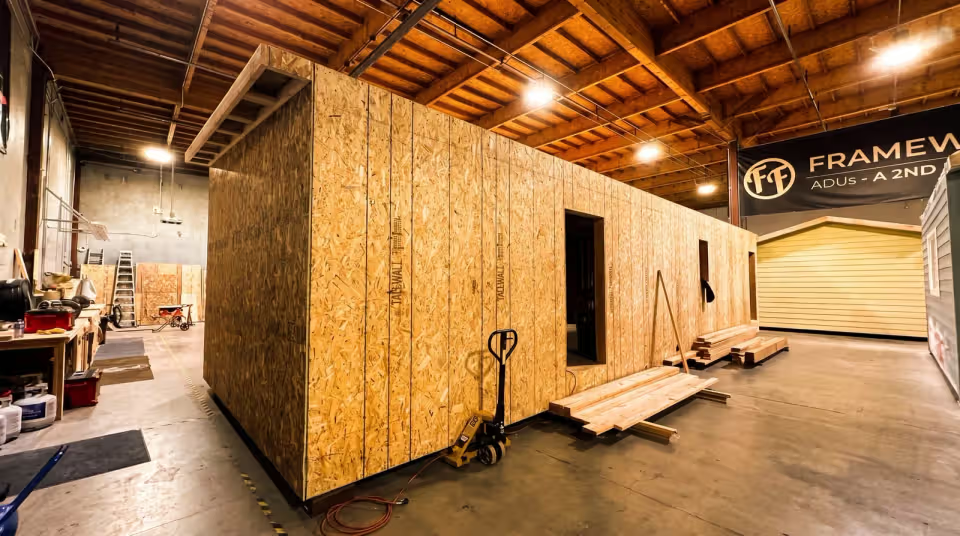
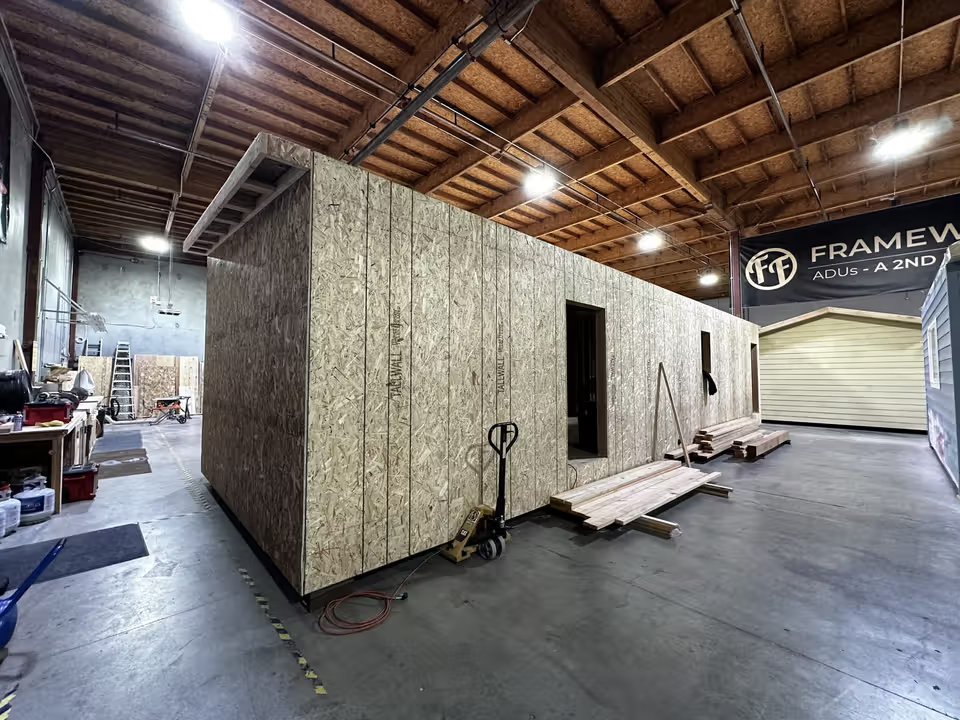
Parts of the county are steep, including the foothills above Los Gatos, Saratoga and Los Altos Hills and the hills around Morgan Hill. A sloped lot can mean extra foundation engineering, grading and access planning, and placement has to respect slope and geologic hazard rules. Some foothill parcels also sit in higher fire hazard zones, which can affect driveway access, defensible space and exterior materials. One state rule does not change: an ADU only needs fire sprinklers if they are required for the main home. Building about 97% of the home in our Salinas factory helps on hard sites, because the site crew can focus on the foundation and terrain while the home is built in parallel. Our guide to ADUs in fire hazard severity zones explains those wildfire rules in more detail.
ADU fees in Santa Clara County
State law sets the biggest fee rules, and they apply in every city and in the unincorporated county:
- Impact fees. None for an ADU of 750 sq ft or less of interior living space. Above 750 sq ft, impact fees must be proportional to the size of the main home. The state’s own example: a 1,000 sq ft ADU next to a 2,000 sq ft house could pay 50% of the fee a new home would.
- School fees. Under state law, school districts may charge them on ADUs larger than 500 sq ft, though they do not have to. San Jose’s ADU FAQ says school fees do not apply below 750 sq ft there and asks owners of larger units to check with their district.
- Utility connection fees. An ADU is not treated as a new residential use when water and sewer connection fees or capacity charges are calculated, unless it is built at the same time as a new single-family home. A new detached ADU can still be charged a connection fee or capacity charge, but it must be proportionate to the ADU’s burden, based on its square footage or plumbing fixtures compared with the main home.
- Building permit fees. Set city by city. San Jose scales them with ADU size, and the County bases them on construction valuation.
Size matters here. Our Four Fifty and The 405 come in under 500 sq ft, and every model through the 749 sq ft Seven Forty-Nine stays at or under the 750 sq ft impact fee line. The line-by-line version is in our Santa Clara County ADU fees guide.
What it costs and how long it takes
A Framework First ADU runs $199,000 to $599,000 all-inclusive. That single number folds in a permitting budget, plans, the foundation, the factory build, delivery and crane set, utility hookups, appliances and the final inspection. Because permit costs are set city by city, we confirm the real figure for your address in the feasibility study rather than guessing at one here.
We build 14 models from 405 to 1,200 sq ft in three styles: Classic Craftsman (our standard), Urban Farmhouse and Ultra Modern. A few points on the lineup:
| Model | Size | Layout | All-inclusive price* |
|---|---|---|---|
| Four Fifty | 450 sq ft | Studio, 1 bath | $199,000 |
| Six Sixty | 660 sq ft | 1 bed, 1 bath | $309,000 |
| Nine Forty-Five Trio Plus | 945 sq ft | 3 bed, 2 bath | $479,000 |
| Twelve Hundred U | 1,200 sq ft | 3 bed, 2 bath | $599,000 |
*Includes a permitting budget, not a final permit total. Permit costs and property-specific site work like septic or retaining walls vary by parcel and are confirmed in your feasibility study.
Most projects take about 4 to 9 months, because the home is built in our factory while permits and the foundation move in parallel. Four months is the best case, on our Four Fifty studio; our 1,200 sq ft homes take about 7 to 9 months, and permitting is the part no builder fully controls. With Silicon Valley rents and land values, the income and resale side of that math is strong here; see how much rent an ADU can earn and ADU appraisal and resale value. Compare the full lineup on our models page or run your own numbers with the ADU cost calculator.
Frequently asked questions
What are the ADU requirements in Santa Clara County?
Every city and the County follow California’s ADU law as the minimum: an allowance of at least 850 sq ft (1,000 sq ft with more than one bedroom), side and rear setbacks of no more than 4 feet, a detached height limit of at least 16 feet, ministerial approval within 60 days of a complete application, and no owner-occupancy requirement for a standard ADU. Your city then adds its own objective standards, like Gilroy’s 1,000 sq ft cap on detached ADUs.
How big can an ADU be in Santa Clara County?
It depends on your city. Every city must allow at least 850 sq ft, or 1,000 sq ft with more than one bedroom, and where a city has no compliant ordinance the state default for a new detached ADU is 1,200 sq ft. Gilroy caps detached ADUs at 1,000 sq ft, the City of Santa Clara describes ADUs as generally 220 to 1,200 sq ft, and the County’s free pre-approved plans come in 800 and 1,200 sq ft sizes. We confirm your exact limit in the feasibility study.
Which Santa Clara County city has the most ADU-friendly rules?
It depends on what matters most for your project. San Jose applies state law directly and runs a dedicated ADU Ally desk. Gilroy caps detached ADUs below the state default at 1,000 sq ft but can issue pre-approved plan permits in about 15 working days. Morgan Hill stays close to the state baseline and runs its own ADU Plans Gallery. Your feasibility study confirms how your city’s rules apply to your lot.
Do I need to live on the property to build an ADU?
Not for a standard ADU. State law bars cities and the County from requiring owner-occupancy, so you can rent out both the house and the ADU, with rentals longer than 30 days. A JADU is different: if it shares a bathroom with the main house, the owner must live in the house or the JADU, and Morgan Hill’s ADU page says the owner must live on the property. Our JADU vs ADU guide explains the difference.
How long does ADU approval take in San Jose?
State law gives San Jose 60 days to approve or deny a complete application. In practice, the city says the first round of building review typically takes about 20 business days, and preapproved plans on qualifying lots can be permitted the same day as the plan review meeting. Incomplete plans are what add extra review rounds. Our San Jose ADU timeline maps the whole project, and our Santa Clara County ADU permit timeline compares the other cities.
What if my property is in unincorporated Santa Clara County?
Then the County of Santa Clara Department of Planning and Development issues your permit, not a city. The County allows ADUs in zoning districts that allow homes, offers free pre-approved 800 and 1,200 sq ft plans, and is amending its ADU ordinance to reflect state law. Expedited review is not available in Wildland Urban Interface, flood or geologic hazard zones. We confirm city or county from parcel records as a first step.
Is the City of Santa Clara different from Santa Clara County?
Yes. The City of Santa Clara is one of the 15 cities in the county and permits ADUs under its own Zoning Code, section 18.60.020. Santa Clara County is the whole county, and the County government only permits ADUs on unincorporated land. Both start from the same state baseline.
Are impact fees waived for small ADUs?
Yes. Under state law, an ADU of 750 sq ft or less of interior living space pays no impact fees to cities, special districts or water corporations, anywhere in the county. Above 750 sq ft, impact fees must be proportional to the main home. School fees follow a separate rule: districts may charge them on ADUs larger than 500 sq ft.
Every lot in Santa Clara County answers to one of 16 permit counters, and the fastest way to know yours is to look at the parcel itself. Book a free Online Property Analysis for a first read from our team. The feasibility study, $497 for a standard lot or $997 for an empty lot, then confirms your city’s rules, your permit path and your all-inclusive number. It is refunded in full, minus payment processing fees, if your property cannot host an ADU, and credited toward your build if you sign with us within 90 days.