ADU Financing · 2026
Adding an ADU to a Rental Property in California

Yes, you can add an ADU to a house you already rent out, and in California you do not have to live on the property to do it. State law stops cities from requiring owner-occupancy for a standard ADU, although a city can require that the unit be rented for 30 days or longer. What changes on a rental is the money and the people: financing a home you don’t live in has fewer options, and your tenants need notice and a plan while the work happens.
The short version: You can rent out both the main house and a new ADU without living on site. Plan on long-term rentals, expect a narrower set of loan options than on your own home, give tenants written notice before work days, and talk with a tax professional about depreciation. Your feasibility study confirms the parcel-specific rules, fees, and costs before you commit.
On this page
The owner-occupancy question
Government Code Section 66315 says a city or county cannot add standards to an ADU beyond the ones the state sets, “including an owner-occupant requirement.” The one exception is a local rule that the property be used for rentals of 30 days or longer, and ADUs approved under the state’s streamlined path in Section 66323 must be rented for longer than 30 days. The same chapter lets an ADU be rented separately from the main house, but it generally cannot be sold separately. For the full set of rental rules, see California ADU rental laws, and if you may move into one of the units later, read can I live in my ADU and rent out my main house.
Junior ADUs work a little differently. A JADU is 500 square feet or less and sits entirely inside the existing house. Since January 1, 2026, owner-occupancy applies to a JADU only when it shares bathroom facilities with the main house, and any JADU rental must be longer than 30 days.
| Standard ADU | JADU, own bathroom | JADU, shared bathroom | |
|---|---|---|---|
| Owner must live on site? | No | No | Yes |
| Minimum rental term | City may require 30+ days | Over 30 days | Over 30 days |
Framework First builds detached, factory-built homes, so the first column applies to our projects. Setbacks, height, and other local standards still apply, and they are confirmed for your parcel in the feasibility study.
Financing an ADU on a property you do not live in
To a lender, a house you rent out is an investment property, which usually means less borrowing room. For conforming loans, Fannie Mae’s cash-out refinance rules set the maximum loan-to-value through its Eligibility Matrix, and individual lenders can be stricter. These limits change over time, so ask each lender for its current maximum on an investment property.
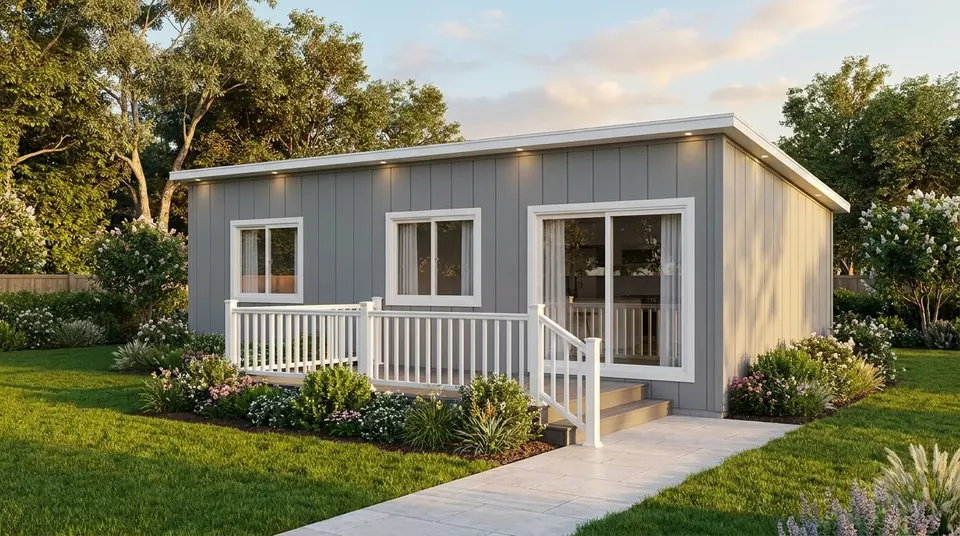
Many landlords start by looking for a HELOC on a rental property. Not every lender offers a line of credit on a home the borrower doesn’t live in, and those that do set their own terms, so ask in the first conversation.
| Option | What to ask the lender |
|---|---|
| Cash-out refinance on the rental | Maximum loan-to-value for an investment property, and what happens to your current rate |
| HELOC or home equity loan on the rental | Whether they lend on non-owner-occupied homes at all, plus draw and repayment terms |
| Equity in the home you live in | How much you can borrow, knowing your own home secures the loan |
| Construction loan | Whether they finance ADUs on investment properties, and how draws are released |
| Cash or savings | No lender needed, but weigh what tying up that cash means for you |
For how a lump sum compares with a line of credit, see home equity loans vs HELOCs for an ADU.
Knowing the build cost before you apply helps. Our 14 models run from $199,000 to $599,000, with plans, foundation, the factory build, delivery, utility hookups, appliances, final inspection, and a permitting budget built into the price. Exact permit costs are set by your city and county and confirmed in your feasibility study, and our pricing page shows what each model includes. Framework First is not a lender, and nothing here is a loan offer, a rate quote, or financial advice.
Running the numbers
For income, start with federal Fair Market Rent data for your area, then check what similar units near your rental actually lease for. Our guide to how much rent an ADU can earn in California walks through it by size. For costs, list your loan payment, property tax on the new construction, landlord insurance that covers a second unit, any shared utilities, and an allowance for maintenance and vacancy.
Fees are one place a smaller unit helps. State law bars impact fees on an ADU with 750 square feet of interior livable space or less, though connection fees and capacity charges are separate. Six of our models fall in that range: The 405, Four Fifty, Five Five Five, Six Sixty, Six Sixty Duo, and the 749 square foot Seven Forty-Nine. Your feasibility study confirms what your city and utilities actually charge. For how rent, cost, and equity fit together, read average ADU ROI in California, and treat any return as an estimate to test, not a promise.
Building next to current tenants
Your tenants live there while the ADU goes in, so a little planning goes a long way.
- Read the lease first. If the yard, driveway, or parking is part of what your tenant rents, building there changes what they rent. Talk with them early.
- Give written notice before entering their home. If the work means going inside the tenant’s unit, for example to reach an electrical panel, California Civil Code Section 1954 requires reasonable written notice with the date, approximate time, and purpose of the entry (24 hours is presumed reasonable), during normal business hours.
- Flag the crane day. The finished home is craned into place in a day, and the street or driveway may be tied up for part of it.
- Plan utility connection days. Tying the ADU into water, sewer, and power can mean a short planned shutoff at the main house.
- Sort out the meters. If a tenant’s gas or electric meter will also serve the new ADU, Civil Code Section 1940.9 requires you to disclose it and agree in writing on who pays for that service.
- Check the Tenant Protection Act. California’s rent cap and just-cause rules have exemptions, including one for housing issued a certificate of occupancy within the last 15 years and one for a home that can be sold separately from any other dwelling unit. Ask a landlord-tenant attorney whether adding an ADU changes how these apply to your main house.
The California Department of Real Estate’s landlord-tenant guide covers entry, notice, and shared utilities. It isn’t legal advice, and neither is this article, so talk with a landlord-tenant attorney about your situation.
Factory building helps here. About 97% of a Framework First home is built in our Salinas factory while the foundation goes in, so your tenants see far fewer construction days than a site-built project brings. A member of our team checks crane access and utility hookups ahead of time, and status updates by text and email make accurate tenant notice easier.
Taxes on a rental ADU
IRS Publication 527 covers residential rental property. Rent is generally taxable income, and ordinary rental expenses can be deducted against it. The cost of building the ADU is an improvement, so it is recovered through depreciation rather than deducted at once, starting when the unit is ready and available for rent. Residential rental property is depreciated over 27.5 years under the general system (IRS Publication 946 has the details), and land is not depreciable.
The Santa Clara County Assessor explains that California assessors treat an ADU like a home addition: the new unit is assessed at market value as of completion and added to your existing assessment, and the existing home is not reassessed. Our guide to ADUs and property taxes in California goes deeper, and a tax professional who works with landlords can map out your federal and California returns.
Which models fit a rental property
On a lot that already has tenants, a compact footprint leaves more yard for the main house.
| Model | Size | Beds / baths | Price | Typical timeline* |
|---|---|---|---|---|
| Five Five Five | 555 sq ft | 1 / 1 | $279,000 | About 5 months |
| Six Sixty | 660 sq ft | 1 / 1 | $309,000 | About 5 months |
| Six Sixty Duo | 660 sq ft | 2 / 1 | $339,000 | About 5 months |
| Seven Forty-Nine | 749 sq ft | 2 / 1 | $369,000 | 5 to 6 months |
| Nine Forty-Five Trio Plus | 945 sq ft | 3 / 2 | $479,000 | About 6 months |
*Prices include a permitting budget. Exact permit costs and any property-specific site work are confirmed in your feasibility study. Permitting, which no builder fully controls, can add time. Timelines are estimates that run from the day your construction deposit lands to final inspection, not from the day you sign.
The Six Sixty Duo is our top pick for most rentals, with two bedrooms in a 660 square foot footprint. We compare the options in the best ADU for rental income, and the best ADU for first-time investors covers lower-entry picks. You can also design and price any of our 14 models in The ADU Designer by Framework First, with no sign-up required.
Frequently asked questions
Can I build an ADU on a house I rent out?
Yes. California law does not allow cities to require owner-occupancy for a standard ADU, so you can add one to a property you rent out. Your city can require rentals of 30 days or longer, and local standards like setbacks still apply.
Can I get a HELOC or home equity loan on a rental property to build an ADU?
Sometimes. Some lenders offer a line of credit or a home equity loan on a non-owner-occupied home, but not all do, and terms vary by lender. Other paths include a cash-out refinance on the rental, borrowing against the home you live in, a construction loan, or cash.
Do I need to live in the main house or the ADU?
No, not for a standard ADU. Owner-occupancy only applies to a junior ADU that shares bathroom facilities with the main house.
Can I rent out both the main house and the ADU?
Yes. You can rent the main house and the ADU to separate tenants at the same time. The ADU generally cannot be sold separately, so both units stay under one ownership.
Are there restrictions on renting out an ADU in California?
The main one is the rental term. Cities can require ADU rentals of 30 days or longer, and ADUs approved under the state’s streamlined path must be rented for longer than 30 days, so check your city’s rules before planning any short-term rental, and plan around long-term tenants.
Is rental income from an ADU taxable?
Generally, yes. IRS Publication 527 explains that rental income is taxable, ordinary rental expenses are deductible, and the cost of building the ADU is recovered through depreciation. A tax professional can apply it to your situation.
Own a rental in Salinas, San Jose, Santa Cruz, or elsewhere in Monterey, Santa Cruz, San Benito, or Santa Clara County? Book a free Online Property Analysis and our team will walk you through which models fit your lot and how the build would work around your tenants. From there, a feasibility study confirms the rules, fees, and costs for your exact parcel.