Buying Guide · Property Tax
Does an ADU Increase Property Taxes in California? (2026)

Yes, building an ADU raises your property taxes, but only on the value the new construction adds. Your existing home keeps its Proposition 13 assessed value, and the county assessor adds a new base year value for the ADU once it is finished. No California county reassesses your whole property at market value when you add one.
The short version: Only the ADU is taxed as new value. Once it passes final inspection, the assessor values the new construction and the county sends a supplemental tax bill for the rest of that tax year, and the ADU is part of your regular annual bill from then on. The rule comes from state law, so it works the same way in every county. This is general information, not tax advice. Confirm the details with your county assessor or a CPA.
On this page
How the new construction assessment works
Under Proposition 13, your property is taxed on its base year value, which is generally its market value when you bought it, raised by no more than 2% a year for inflation. California resets that value to current market value only when a property changes ownership or new construction is completed, as the State Board of Equalization (BOE) explains in its California property tax overview.
Building an ADU is new construction, but it does not wipe out the base year value you already have. The BOE’s Assessors’ Handbook on newly constructed property is direct about it: only the value added by the new construction can be added to your existing base year value. In practice, the assessor:
- Keeps your home and land at their existing Prop 13 value, with the usual annual adjustment of up to 2%.
- Sets a new base year value for the ADU alone, based on what the new construction is worth on the date it is completed.
- Adds the two together on your tax bill. You may hear this called a “blended” assessment.
Two details matter for your budget. First, the assessor values the new construction itself, and the handbook notes that this value is “not necessarily the same as the cost.” Your construction price is often a useful guide, but the assessor can also look at comparable sales, so the number can land above or below what you paid. Second, your land is not revalued just because your neighborhood appreciated. Increases in land value from appreciation, rather than from new construction, are not added.
What makes the ADU’s value larger or smaller is the work itself: its size and bedroom count, its finish level, and improvements that come with it, such as a porch or patio. Once the ADU’s base year value is set, it follows the same Prop 13 rules as the rest of your property and can rise by no more than 2% a year.
When the higher bill shows up
You will not see the full increase the day your permit is issued. Here is the usual sequence, based on the BOE handbook and overview:

- Your permit reaches the assessor. City and county building departments are required to send the assessor copies of building permits, so the assessor learns about your ADU from the permit itself.
- January 1 during construction. If your ADU is still under construction on January 1 (the lien date), the assessor can value the work in progress as of that date. Once the ADU is finished, that interim value is replaced by the completed value.
- Completion. For tax purposes, the ADU is complete when it is available for use, which for a permitted ADU generally means it has passed final inspection and been approved for occupancy. Cities and counties must send the assessor a copy of the certificate of occupancy or similar completion document within 30 days of issuing it.
- The supplemental bill. Instead of waiting for the next regular tax year, the county issues a supplemental assessment for just the ADU’s added value, prorated for the rest of the fiscal year (July 1 through June 30). If the ADU is completed between January 1 and May 31, expect two supplemental bills: one for the rest of the current fiscal year and one for the entire next fiscal year. If it is completed between June 1 and December 31, expect one.
- Your regular annual bill. After that, the ADU is simply part of your normal property tax bill.
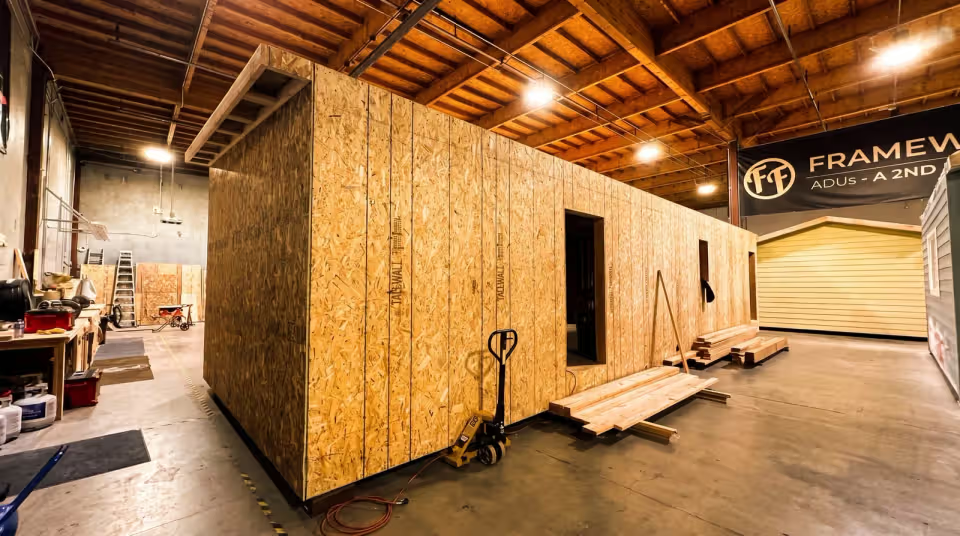
Our homes are about 97% built off-site in our Salinas factory, but the completion date that matters for your taxes is still the day the finished ADU on your property is approved for occupancy.
A few practical notes:
- A supplemental bill is its own bill, with due dates that depend on when it is mailed. If your mortgage lender pays your property taxes through an impound account, ask whether it also pays supplemental bills.
- You can appeal the value. For a supplemental assessment, the BOE overview says the appeal generally must be filed within 60 days after the notice is mailed. Los Angeles County, and any other county whose board of supervisors has adopted an alternative resolution, allows 60 days from the mailing date printed on the tax bill or the postmark date, whichever is later.
JADUs and garage conversions
The same rule applies when the new living space is inside your home or converted from an existing structure: only the value of the new work is assessed.
- Garage conversions. The BOE handbook specifically lists converting a garage into living area, and finishing previously unfinished space such as a garage, as assessable new construction. The assessor adds the value of the physical work, and any value that comes purely from the change in use is excluded. Our guide to garage conversion to ADU covers the build side.
- JADUs. A junior ADU is created within the walls of your existing home, so the new work is usually smaller in scope than a detached ADU, and only that work is assessed. Our JADU vs. ADU comparison covers the size limits and owner-occupancy rules.
Because the assessor sets the number based on the work itself, the dollar amount varies by county and by project.
Is it different in LA, Monterey or Santa Clara County?
No. How new construction is assessed is set by state law, not county policy. The BOE overview explains that each county assessor is governed by the California Constitution, the laws passed by the Legislature and the rules adopted by the BOE, and that an individual county government does not control the assessor’s tasks. Whether you build in Los Angeles County or in Monterey, Santa Cruz, San Benito or Santa Clara County where our team works, only the ADU is added to your assessment.
What does differ from place to place:
- The value your assessor puts on your ADU, which depends on your parcel and your local market.
- Your total tax rate, because voter-approved rates are added on top of the 1% base, and they vary from one area to another even within the same county.
- Procedural details, like the supplemental appeal window noted above.
Estimating your increase before you build
You can get close with two numbers: the value the ADU is likely to add, and your total tax rate.
Your rate starts with the 1% base set by Proposition 13. On top of that, your bill includes rates for local voter-approved bonds and other indebtedness, which vary by tax rate area. The simplest way to find yours is your current property tax bill, which typically shows your total tax rate as a percentage, separate from any flat-dollar direct charges. Multiply the value the ADU adds by that percentage rate, and you have a reasonable estimate of the added annual tax.
Here is a worked example. It is an illustration only, not a quote or a prediction for your property.
| Illustration | Amount |
|---|---|
| Value the assessor adds (assumed equal to the all-inclusive price of our Six Sixty) | $309,000 |
| Added tax at the 1% base rate | $3,090 a year |
| Each extra 0.1% of voter-approved rates on your bill | About $309 a year more |
| Your existing home’s assessed value | Unchanged, plus the normal annual adjustment of up to 2% |
Keep in mind that the assessor’s value can come in above or below what you paid, and your first supplemental bill covers only part of a year. For planning, our ROI calculator builds in a property tax allowance of 1.25% of the ADU’s cost each year. That is a planning placeholder, not a prediction, and the projections you run there already account for it. Your county assessor’s office can explain how it typically values ADUs locally.
Does the rent cover it?
If you rent the ADU, the added property tax becomes one predictable line item set against monthly rent. In the illustration above, $3,090 a year at the 1% base rate works out to about $258 a month, before any voter-approved rates on your bill, so you can set it directly against the rent ranges in our rent guide. How much rent your ADU can earn depends on its size, location and finish, and we walk through the ranges in how much rent an ADU can earn in California.
Rental income is taxable, but IRS Publication 527 explains that rental expenses such as taxes, insurance and interest can generally be deducted from it, and IRS Publication 946 covers depreciation. How this applies depends on your situation, so talk it through with a CPA.
It also helps to separate two numbers that often get mixed up. Your assessed value drives your tax bill. What the ADU adds to your home’s market value is a separate question, covered in our ADU appraisal and resale value guide. For the full picture of whether the numbers work for your family, see is an ADU worth it.
Other costs to plan for
- Permit fees are a one-time cost, separate from property tax. Every Framework First home is priced all-inclusive with a permitting budget built in, and your exact permit costs are confirmed for your property in your feasibility study. Our guide to how much an ADU costs in California covers model pricing from $199,000 to $599,000.
- Insurance. Your homeowner’s policy needs to account for a second dwelling on the property. See what changes with ADU insurance.
- Selling later can raise capital gains questions, and the answer depends on your situation. Plan that conversation with a CPA too.
We are builders, not tax advisors, so treat this guide as a starting map rather than advice.
Frequently asked questions
Does an ADU increase property taxes in California?
Yes, but only on the value the ADU adds. Your existing home and land keep their Proposition 13 assessed value, and the county assessor adds a separate base year value for the new construction once it is complete. The increase is roughly the ADU’s assessed value multiplied by your total tax rate.
Will my whole property be reassessed if I build an ADU?
No. California law limits the reassessment to the new construction. Your main home keeps its current base year value, and your land is not revalued for general appreciation. Only the ADU is added at current value.
When does the ADU reassessment happen?
When the ADU is complete for tax purposes, which generally means it has passed final inspection and been approved for occupancy. The county then sends a supplemental bill for the rest of that fiscal year (two bills if it is finished between January 1 and May 31), and the ADU is part of your regular annual bill after that. If construction is still underway on January 1, the work in progress can be valued as of that date.
Does LA County reassess your whole property when you add an ADU?
No. Los Angeles County follows the same state rules as every other California county. The assessor values only the new ADU and adds it to your existing assessment, and your main home keeps its Prop 13 value.
Does a JADU or garage conversion raise property taxes?
Yes, by the value of the new work only. The BOE lists converting a garage into living area as assessable new construction, and the same principle applies to a JADU built inside your home. The assessor sets the value, so the amount varies by county and by project.
Can I estimate my property tax increase before I build?
Yes, roughly. Multiply the value the ADU is likely to add by the percentage tax rate on your current bill, which is the 1% Prop 13 base plus local voter-approved rates (leave out any flat-dollar direct charges). Your county assessor’s office can explain how it values ADUs, and keep in mind that the assessor’s number can differ from your construction cost.
Does financing the ADU change how it is taxed?
No. The assessment is based on the value of the new construction on the date it is completed, not on how you paid for it. Paying cash, using a HELOC or taking a construction loan all lead to the same assessment.
Want real numbers for your property before you decide? Start a feasibility study. Our team reviews your lot, confirms your permit costs and site work, and gives you a clear cost picture to plan around. For the property tax side, your county assessor’s office can tell you how it values ADUs locally. The study is $497 for a standard lot or $997 for an empty lot, and it is credited toward your build if you sign with us within 90 days.