ADU Permits · 2026
Can You Remove a Tree to Build an ADU? Permits Explained

Can you remove a tree to build an ADU? Often yes, with a permit, and sometimes no. Most cities we build in protect trees above a set trunk size, so removing one to make room for an ADU usually means a tree removal permit, replacement trees, and sometimes a certified arborist’s report. In San Jose, an ordinance-size tree on a single-family lot needs a permit even if it is dead. Of the cities covered here, Carmel-by-the-Sea sets the strictest bar: removing a tree the city classifies as significant to make room for construction is prohibited except under narrow findings. On most lots, smart placement beats removal.
The short version: A tree touches a factory-built ADU three ways: the permit, the crane’s path, and the roots under the foundation. Each city sets its own thresholds and replacement rules, and state ADU law does not erase them. We look at trees, crane access and placement before design, so a likely tree permit shows up early.
On this page
Why trees matter more for a factory-built ADU
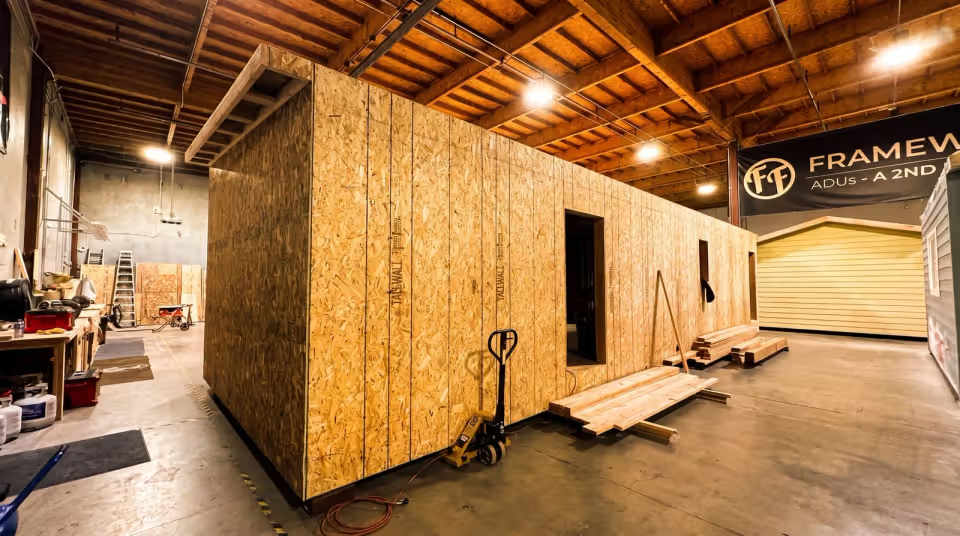
Our homes arrive about 97% complete from our Salinas factory and are lifted by crane onto the foundation in a single day. That makes a tree a three-part question:
- The permit. Whether the tree can come out at all, and what replacement is owed.
- The crane and the delivery route. Branches over the street, the crane’s swing path, and the staging area all need clearance. Our post on how ADU crane delivery works walks through delivery day.
- The roots. Footings and utility trenches run through the root zone, and cities regulate that too. Carmel requires a permit to cut roots over 2 inches in diameter, and Pacific Grove counts removing any root 4 inches or larger as substantial pruning. Saratoga requires a Tree Protection Plan in the plan set for building permits that involve foundation work or trenching, including for a neighbor’s tree that overhangs your property.
Even trimming for the crane can need a permit. Los Gatos requires one to prune more than 25% of a protected tree within three years, Saratoga to prune more than 25% of a protected tree’s canopy, and San Jose to prune a street tree. That is why access gets planned at the site visit, well before delivery day, as our site preparation guide explains.
Tree removal permit rules by city
Most cities measure trunk size at breast height, about 4.5 feet above the ground (Los Altos measures at 48 inches). Here is what each city’s official tree page says is protected on a typical home lot:
| City | Protected on a typical home lot | What it means for an ADU |
|---|---|---|
| San Jose | Ordinance-size trees, 38 inches or more in circumference (about 12.1 inches in diameter), live or dead; heritage and street trees | A tree that blocks a proposed improvement can qualify for removal, with a 10 day public notice for a healthy one |
| Los Gatos | 12 inches in diameter; 8 inches on hillside lots and for blue oak, black oak, California buckeye and Pacific madrone; 4 inches when removal relates to development review | A tree protection plan is required when a protected canopy reaches into or near the project |
| Saratoga | 10 inches in diameter for any species; 6 inches for listed natives such as coast live oak and coast redwood | Excavation for a foundation triggers the Tree Protection Plan requirement |
| Los Altos | 12 inches in diameter; 10 inches for native species | Requests need an arborist report and a replacement plan; removals tied to a project are reviewed with it |
| Palo Alto | 11.5 inches for natives such as coast live oak and valley oak; 18 inches for coast redwood; 15 inches for most other mature trees | Get the Tree Removal Permit before you submit the building permit |
| Monterey | Private trees larger than 6 inches in trunk diameter | The city may ask for a report from an ISA certified arborist |
| Pacific Grove | 6 inches for coast live oak, Monterey cypress, Monterey pine and a few others; 12 inches for all other species; Gowen cypress at any size | When tree work is tied to development, the Planning Department sets the permit path |
| Carmel-by-the-Sea | 4 inches for oak, pine, cypress and redwood; over 10 inches for other species; over 2 inches on a property with an active building permit | Once your building permit is active, even small trees need a permit to come out |
Ordinances change (Palo Alto’s latest update took effect May 1, 2024), so we check the current code for your parcel rather than relying on any summary, including this one. See San Jose’s tree removal permits page, the Los Gatos tree permit FAQ and private trees page, Saratoga’s trees page, Los Altos tree removal, Palo Alto’s tree ordinance information, Monterey’s tree ordinance facts, Pacific Grove tree permits and Carmel’s tree permits page.
Unincorporated and coastal parcels. Outside city limits, county rules apply. Monterey County’s tree removal permit procedures state that in the coastal zone, removing any native tree requires a Coastal Development Permit, and Pacific Grove notes one may be needed in the Asilomar Dunes habitat area. Our guide to ADUs in Monterey County’s coastal zone covers that review.
Does California ADU law override a tree ordinance?
Not directly. State ADU law requires cities to approve ADUs ministerially, using only objective standards, within 60 days of a complete application. The state’s ADU Handbook (March 2026 edition) explains that local objective standards are allowed, naming landscape standards among them, and that limits such as lot coverage, open space and front setbacks cannot block at least an 800 square foot ADU with 4 foot side and rear setbacks. It does not carve ADUs out of local tree ordinances, so plan on your city’s tree rules applying.
Several cities already account for new building in their removal criteria. San Jose will consider removing an ordinance-size tree that stands in the way of a proposed improvement of the parcel. Los Altos asks whether preserving the tree would impede use of the property with no feasible alternative. Palo Alto allows a development-related removal when keeping the tree would cut buildable area by more than 25% with no financially feasible design alternative. Carmel sits at the strict end. How these rules meet on your lot varies by parcel, and it is confirmed in the feasibility study.
Options before removal
Removal is rarely the first move. In rough order, here is what we look at:
- Shift the footprint. Moving the home a few feet out of a tree’s protection zone is often the simplest fix. Los Gatos, for example, describes a fenced zone at or beyond the dripline where no soil disturbance is allowed without arborist approval.
- Choose a narrower model. Our narrowest homes, from The 405 and the Four Fifty to the Six Sixty Duo, are 15 feet wide, while the Seven Forty-Nine and larger homes are about 30 feet wide. Compare footprints on our models page.
- Protect the roots. Where an arborist recommends it, foundation and utility routes can be laid out to limit digging inside the root zone.
- Prune with a permit. If one limb is the only conflict with the crane, a pruning permit is a far smaller ask than removal.
- Get the arborist in early. If a protected tree is close to the build area, a report up front helps avoid a redesign during plan check.
- Plan the replacements. Los Gatos sizes replacement trees by canopy and allows an in-lieu fee when they cannot reasonably fit on site, San Jose lets single-family lots mitigate at a 1:1 ratio, and Los Altos requires 1:1 with at least a 24 inch box tree. In Los Gatos and Carmel, replacements go in before final inspection.
Timing and cost
Tree review adds its own steps to the schedule. A few examples straight from city pages:
| Step | What the city says |
|---|---|
| Arborist decision | Los Gatos: generally 10 to 15 business days after a complete application, longer if neighbors must be notified |
| Public notice | San Jose: a 10 day notice period and a posted yard notice when a healthy ordinance-size tree is removed to improve a parcel, and neighbors can request a Director’s Hearing; Los Altos: once the permit is issued, a notice stays posted on the property for at least 10 calendar days before removal, and the decision can be appealed in that window |
| Processing target | Los Altos: about 30 days; Carmel: 6 to 8 weeks for non-emergency requests |
| Nesting season | Los Gatos asks owners to check for active bird nests before removal, particularly from February 1 through August 31 |
Permit fees, replacement trees, in-lieu fees and arborist reports are set city by city and change often, so we do not quote them from memory. Your feasibility study includes a permit cost and timeline projection for your city and a preliminary site plan, so a tree in the way shows up before you commit to a build. Whether a tree is protected, and whether an arborist report is needed, is confirmed with your city. From there our team handles your ADU permit for you. Costs tied to a specific tree, such as an arborist report, the removal itself, replacement trees or an in-lieu fee, are property-specific, so they are confirmed in your feasibility study before you sign rather than assumed in the model price. Some cities also ask the property owner to sign the tree permit application.
Frequently asked questions
Do I need a permit to remove a tree for an ADU in San Jose?
Yes, if it is a street tree, a heritage tree, or an ordinance-size tree, meaning 38 inches or more in circumference measured 4.5 feet above the ground. On a single-family lot, an ordinance-size tree needs a permit even if it is dead, while a smaller tree in none of those groups can come out without one.
Can a city deny my ADU because of a protected tree?
Not for the tree alone. The ADU application is reviewed ministerially under objective standards, but the tree is judged under your city’s tree ordinance, sometimes as a separate permit (Palo Alto) and sometimes as part of the project review (Los Altos). A city can deny the removal, which usually means moving the ADU, and in some cities, Carmel most of all, that bar is high. The usual answer is to design around the tree before plans are drawn.
What is an arborist report and when do I need one?
It is a written assessment by a certified or consulting arborist covering each tree’s species, size and condition, plus how to protect it during construction. Los Altos requires one with every removal request; San Jose, Monterey and Los Gatos may ask for one.
Can the crane lift a home over trees?
Often, yes. The crane lifts each module from the truck over fences, the house or trees and sets it on the foundation. Crane position, lift path and any pruning are set during the site visit, and pruning beyond a city’s limits needs its own permit.
Will tree removal delay my ADU?
It can, mostly when a tree is discovered late. Notice periods, arborist reviews and nesting season are far easier to plan around when they are on the schedule from the start, and a tree that shows up on the feasibility study’s preliminary site plan can move forward alongside design. Timing varies by parcel and by city.
Map your trees before you pick a spot
The right answer for your lot depends on which trees are protected, where the crane can stand, and where the home fits. Start with a free Online Property Analysis, then a feasibility study whose preliminary site plan shows where your ADU can go around the trees you have.